National restoration initiatives
promote China's marine ecosystem recovery -- Ocean
University of China First Proposes a Comprehensive
Effectiveness Evaluation Framework for
National-Scale Marine Ecosystem Restoration
Jul 17, 2026, Ling Meng
Under the
dual pressures of human activities and climate change,
global coastal ecosystems have generally deteriorated,
making marine ecosystem restoration (MER) an important
means to address the challenge. However, cross-regional
and multi-MER projects involve a large number of
restoration units with widely distributed spatial
patterns and interrelated functions. Traditional
engineering-scale assessment indicators are difficult to
apply to the assessment of national overall restoration
actions, and monitoring data are not easily accessible,
leading to methodological bottlenecks in the
comprehensive effectiveness evaluation of national and
even global-scale restoration. Since 2016, a series of
China's Marine Eco-environmental Restoration Programme
(CMERP) have been implemented, covering various
ecosystem types such as coastal wetlands, sandy beaches,
and mangroves. However, systematic and comprehensive
quantitative assessments have been lacking previously.
Addressing
this issue, SARCCM at Ocean University of China, in
collaboration with the National Disaster Reduction
Center for Marine Disasters of the Ministry of Natural
Resources of China, Ludong University, and the
University of Tasmania, recently published research
titled ‘National restoration initiatives promote China’s
marine ecosystem recovery’ in Communications Earth
& Environment. The study takes 81 CMERPs in
China from 2016 to 2022 as examples. On this basis, an
evaluation framework encompassing three dimensions:
restoration stability, ecological benefits, and economic
benefits, is constructed. The indicator weights are
determined through the Analytic Hierarchy Process (AHP).
For the first time, the Marine Ecological Restoration
Effectiveness Index (MERE Index) is proposed (Fig. 1),
and robustness tests are conducted on the index using
indicators such as mean absolute deviation, mean rank
shift, and correlation coefficient.
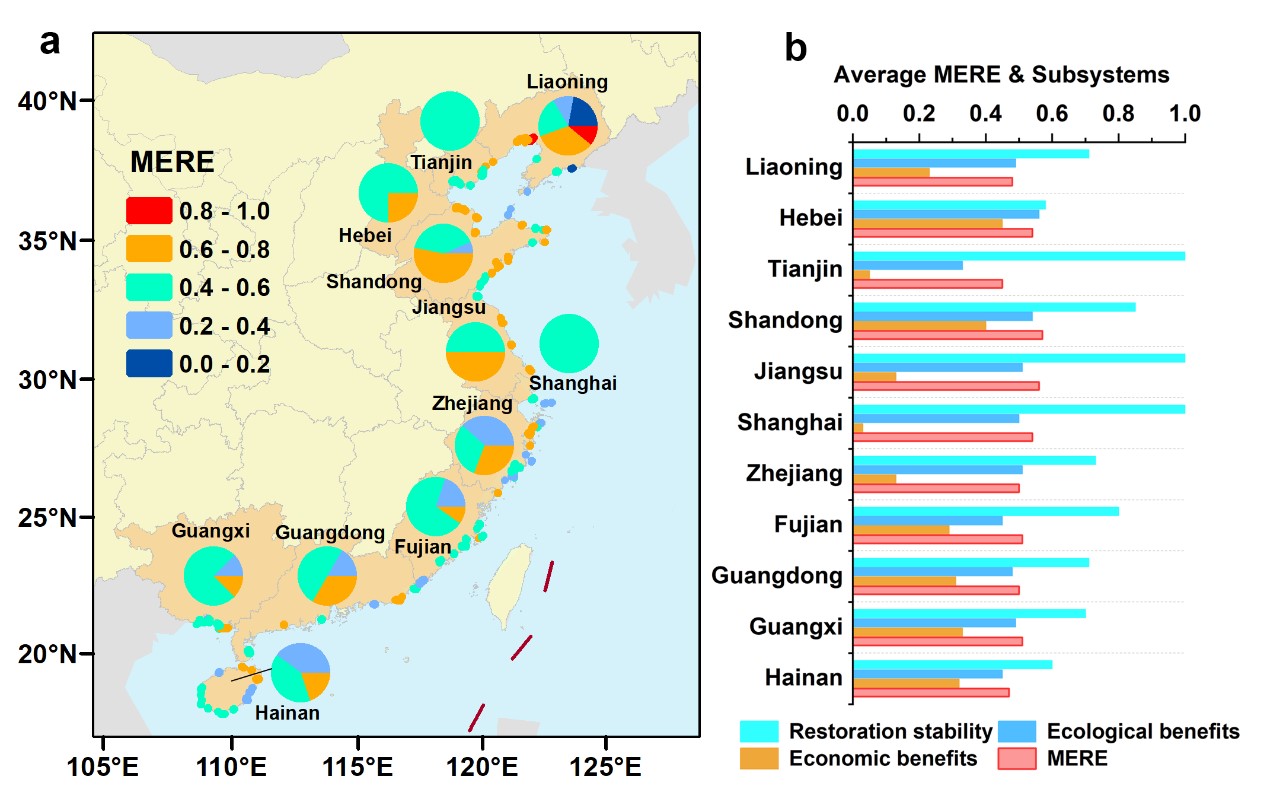
Fig. 1 Application of
the MERE index to assess the CMERP.
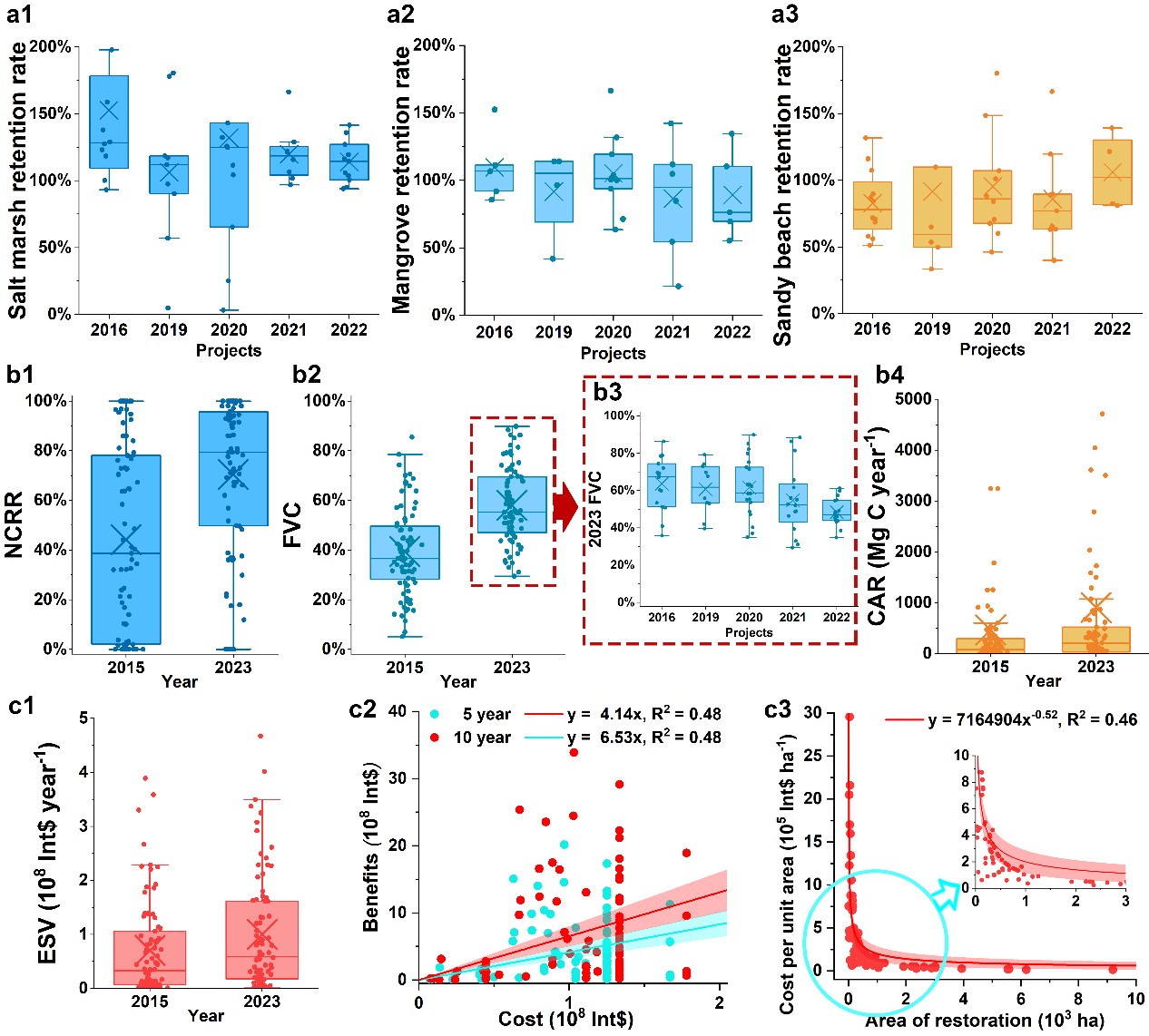
Fig.
2 The prestandardization indicator values of CMERP
include restoration
stability, ecological benefits, and economic
benefits.
The
results showed that 81 CMERPs have cumulatively
restored 15,423 hectares of
salt marsh wetlands, equivalent to 23.99% of the total
loss of salt marsh
wetlands over the past 27 years (1984-2011).
Additionally, 3,238 hectares of
mangrove forests have been restored, representing
14.23% of the damaged
mangrove forest area over the past 65 years
(1950-2015). Within these 81
restoration areas, the natural shoreline retention
rate doubled, increasing
from 38.62% before restoration to 79.44% after
restoration, gradually
transforming fragmented artificial coasts into
continuous natural coasts.
Vegetation coverage significantly increased from
36.58% to 55.29%. The mangrove
and salt marsh vegetation community structure
continued to recover, initially
forming a situation where artificial restoration
drives natural recovery. The
blue carbon storage capacity was significantly
enhanced, with the total carbon
accumulation rate in the restoration areas increasing
by 94.85%, and the total
annual carbon sequestration reaching 73438.87 Mg C.
The socio-economic benefits
were remarkable, with the total value of regional
ecosystem services increasing
by 41.71%, and the annual comprehensive ecological
value reaching approximately
29.6 billion yuan (Fig. 2). However, CMERP are only a
part of China's
restoration efforts, and there are still many
restoration actions by local
governments and enterprises that have not yet been
counted. These restoration
actions will collectively promote China's ecological
environment restoration
and sustainable development.
This
study has overcome methodological bottlenecks,
providing a data-accessible,
robustly indexed, and replicable evaluation framework
for the comprehensive
effectiveness assessment of MER across regions and
multiple ecosystems.
Meanwhile, by taking the excellent comprehensive
effectiveness of China's
national restoration actions as a case study, it
offers a scientific reference
for the comprehensive effectiveness assessment of
restoration at regional and
even global scales.
Paper
Information:
Xiao Chen, Nan Wang,
Xianwen Bao, Wen Wu, Xinping Chen, Ping Dong, Simon
Williams, Jing Yu, Lingling
Zhou, Yang Ding, Dehai Song. 2026. National
restoration initiatives promote
China’s marine ecosystem recovery. Communications
Earth & Environment.
doi.org/10.1038/s43247-026-03760-0.
Corresponding
author:
Nan Wang (E-mail: wangnan0515@ouc.edu.cn)
Link:https://www.nature.com/articles/s43247-026-03760-0